

Latex Pillows Market Size Worth $2.53 Billion by 2033, Growing at 8.7% CAGR as Pressure-Relief Sleep Preferences and Hygiene-Led Healthcare Buying Drive Global Demand – Verified Market Research
The Global Latex Pillows Market is valued at $1.30 Billion in 2025 and is projected to reach $2.53 Billion by 2033, according to a new industry analysis from Verified Market Research®. Demand is accelerating as consumers prioritize pressure relief and durability, while healthcare facilities and hospitality operators adopt hygiene-focused procurement standards. Blended Latex Pillows lead segment growth on the strength of balanced comfort and affordability, while North America commands roughly 40% of global market share on premium, eco-friendly latex demand. The Latex Pillows Market Growth outlook through 2033 reflects sustained adoption across residential, hospitality, healthcare, and travel & leisure channels.
Lewes, Delaware, July 22, 2026 (GLOBE NEWSWIRE) -- According to Verified Market Research®, the Global Latex Pillows Market Size was valued at $1.30 Billion in 2025 and is projected to reach $2.53 Billion by 2033, expanding at a Compound Annual Growth Rate (CAGR) of 8.7% during the 2025 - 2033 forecast period. The comprehensive analysis, titled "Latex Pillows Market Size By Type (Natural Latex Pillows, Synthetic Latex Pillows, Blended Latex Pillows), By Application (Residential Use, Hospitality Industry, Healthcare Facilities, Travel & Leisure), By Geographic Scope And Forecast," covers five regions, seven market segments, and ten key industry players across more than 240 pages of in-depth research.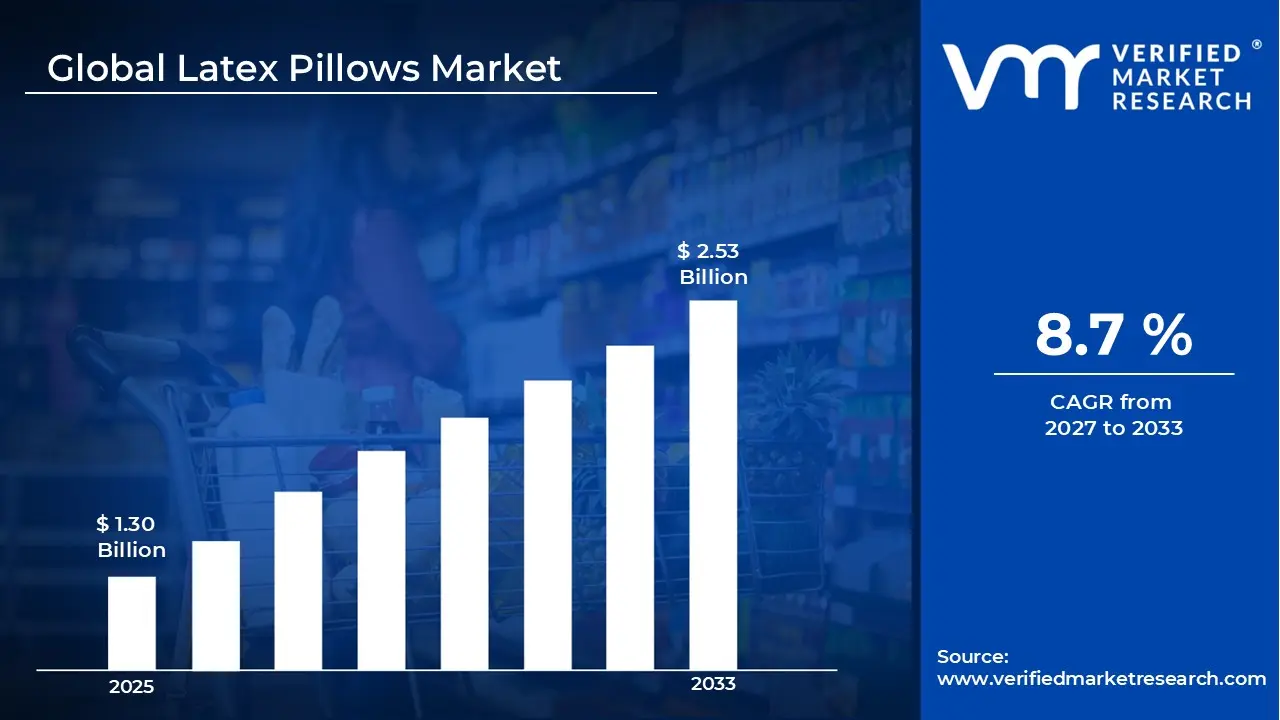 Download a free sample to access exclusive Insights, Data Charts, And Forecasts From Latex Pillows Market Sample Report
The Latex Pillows Market Growth trajectory is being shaped by a convergence of consumer wellness priorities and institutional procurement standards. As buyers increasingly associate sleep comfort with long-term health outcomes, latex-based bedding is gaining share against alternative fill technologies, supported by improving manufacturing consistency and expanding hygiene-conscious purchasing across the hospitality and healthcare industries.
Latex Pillows Market Overview: Scope, Definition, and Market Boundaries
The Latex Pillows Market encompasses the manufacture, sourcing, distribution, and sale of pillows whose primary comfort and support structure is built on latex foam. Within this market, participation is defined by the presence of latex material in the pillow's internal cushioning and core components, together with the commercial sale of the finished pillow through retail channels, contract supply arrangements, and institutional procurement pathways. The core function of products within the Latex Pillows Market is to deliver pressure relief, thermal comfort, and postural support through latex-based foam performance characteristics.
The scope of the Global Latex Pillows Market extends across the full value chain, including component sourcing for latex foam production, pillow conversion and finishing, and sales into defined end-use environments such as homes, hotels, healthcare facilities, and travel and leisure settings. Importantly, the report draws clear boundaries around what is excluded from the Latex Pillows Market Industry to avoid analytical ambiguity. Memory foam pillows are excluded because their comfort mechanism relies on viscoelastic polymers rather than latex foam cell structures and rebound behavior. Down and down-alternative pillows are excluded because their comfort mechanism is based on fiber or feather loft rather than latex foam. Feather, polyester, and gel-based pillow systems are similarly excluded whenever latex is not the primary structural material, even though these alternatives compete in the same broad comfort and ergonomics decision space.
Geographically, the Latex Pillows Market Size analysis treats geography as an access and consumption boundary rather than a redefinition of the product itself a latex pillow remains within scope as long as it meets the market's latex-focused product criterion, and it is categorized consistently by type and application across all regions covered in the study.
Why the Latex Pillows Market Is Segmented
The Latex Pillows Market Industry is structurally segmented because demand and value creation do not move in lockstep across product materials and usage contexts. Consumers and institutions select pillows based on differing comfort expectations, performance requirements, pricing tolerance, and purchasing cycles, and a single-market view would obscure these distinctions. Segmentation therefore functions as a lens for understanding how value is distributed, how adoption pathways differ by end use, and how competitive positioning evolves from material technology through to channel fit.
Two interlocking segmentation logics define the Latex Pillows Market: Type, which reflects material and performance orientation, and Application, which reflects the operating environment and procurement behavior behind each purchase decision.
Download a free sample to access exclusive Insights, Data Charts, And Forecasts From Latex Pillows Market Sample Report
Key Growth Drivers Fueling the Latex Pillows Market
The Latex Pillows Market Growth outlook from a 2025 base of $1.30 Billion to a 2033 forecast of $2.53 Billion is underpinned by three primary drivers identified in the Verified Market Research® analysis.
Rising Consumer Preference for Pressure-Relief Sleep Systems
Latex pillows are increasingly aligning with evolving sleep performance expectations because the material's elastic response supports consistent head and neck positioning. As consumers compare comfort outcomes through reviews and return policies, demand is shifting toward systems perceived as durable and body-adaptive rather than purely decorative bedding. This preference is intensifying repeat purchases and upgrades within the Latex Pillows Market, expanding unit volumes and encouraging more households to treat pillows as an ongoing wellness category rather than a one-time purchase.
Hygiene and Allergen-Conscious Purchasing in Healthcare and Regulated Environments
Healthcare facilities and similarly regulated environments face operational pressure to reduce complaints tied to bedding cleanliness and occupant comfort. Latex pillows support hygiene-focused procurement criteria, prompting suppliers to adopt more standardized product labeling and documentation practices. As healthcare and comparable institutions refine supplier evaluations, latex offerings within the Latex Pillows Market are becoming easier to justify in tenders and onboarding cycles translating buyer preference directly into contract-based demand and longer replacement intervals.
Material Innovation and Manufacturing Consistency
More consistent latex formulations, blending strategies, and quality controls are reducing the performance gap between first-time use and long-term wear. As production processes mature, manufacturers can offer tighter specifications on feel, resilience, and durability, lowering the perceived risk for buyers managing large inventories. This operational certainty is supporting faster onboarding by hospitality and healthcare procurement teams, strengthening conversion from product sampling to repeat institutional orders across the Latex Pillows Market.
These core drivers are further amplified by ecosystem-level improvements across supply chain planning, product standardization, and distribution reach. As latex bedding materials move through more predictable sourcing and logistics arrangements, lead times are stabilizing, enabling retailers and institutions to refresh inventory on schedule rather than reacting to shortages. At the same time, industry standardization around specifications and documentation is reducing friction for large accounts, accelerating the translation of comfort and hygiene expectations into sustained purchasing behavior across the Global Latex Pillows Market.
Emerging Opportunities in the Latex Pillows Market
Natural and Blended Latex Positioning for Comfort and Sustainability Expectations
Consumers are increasingly comparing pillow choices by feel, breathability, and perceived materials rather than by brand alone. Natural Latex Pillows and Blended Latex Pillows stand to capture more repeat purchases as manufacturers improve consistency in density, certification messaging, and cover performance across product lines, reducing returns and warranty claims driven by subjective comfort gaps.
Standardized Hygiene and Replacement-Cycle Programs for Healthcare and Travel Settings
Healthcare facilities and travel operators face recurring procurement constraints, including cleaning compatibility and replacement cycle-time. Latex Pillows Market participants can capture unmet demand by offering clearer specifications for care routines, robustness under routine handling, and predictable lifespan disclosures packaging offerings into managed replacement schedules that align with procurement KPIs and reduce operational friction.
Synthetic and Blended Latex Innovation for Mainstream Residential Access
Synthetic Latex Pillows and Blended Latex Pillows can unlock broader adoption when comfort outcomes meet consumer expectations at price points aligned with mass-market buying behavior. By refining material feel, airflow characteristics, and stiffness tuning, manufacturers can narrow the preference gap that currently pushes some buyers toward non-latex alternatives.
Beyond product-level opportunity, ecosystem readiness is a key enabler of Latex Pillows Market Growth. Supply chain optimization for latex inputs including tighter grading and more reliable sourcing can reduce variability that undermines customer confidence. Standardization of labeling, care instructions, and quality benchmarks supports regulatory alignment and procurement workflows, particularly for healthcare facilities and hospitality industry partners, while improved warehousing and replenishment infrastructure allows new entrants and regional brands to participate through smaller, testable assortments.
Download a free sample to access exclusive Insights, Data Charts, And Forecasts From Latex Pillows Market Sample Report
Market Challenges and Restraints
Latex Material Pricing Volatility
Latex pillows are exposed to input and processing cost fluctuations, which tighten gross margins for manufacturers and raise landed prices for buyers. In residential channels, shoppers trade down when perceived value is unclear, slowing conversion from trial to repeat purchases. In institutional procurement, fixed annual budgets and bid requirements amplify this effect, delaying onboarding and stretching decision timelines across the Latex Pillows Market.
Compliance Burden in Healthcare and Hospitality Channels
Healthcare facilities and hospitality operators apply stricter requirements for hygiene controls, performance stability, and documented materials handling. Meeting these expectations typically increases testing, documentation, and quality assurance overhead, particularly for blended and natural latex formulations, lengthening approvals and reducing supplier flexibility.
Supply Concentration and Production Capacity Limits
Latex sourcing and processing require specialized inputs and controlled manufacturing conditions, which can concentrate capacity in fewer production hubs. When demand spikes in residential, travel, and hospitality segments, distribution delays can force stockouts or substitutions, reducing buyer confidence and increasing returns if replacement products differ in comfort or airflow characteristics.
Across the Latex Pillows Market, these restraints are reinforced by ecosystem-level frictions, including standardization gaps in comfort parameters, material composition disclosure, and performance claims, all of which create uncertainty for procurement teams and slow approvals during vendor selection.
Technology and Innovation Trends Shaping the Latex Pillows Industry
Technology within the Latex Pillows Market Industry is centered on material transformation and controlled cellular structure formation, which directly governs the elasticity, resilience, and pressure response that consumers associate with latex pillows. Production capability relies on repeatable processes that manage latex compounding, maturation, and shaping so that firmness and buoyancy remain stable from batch to batch.
Process Control for Consistent Comfort Across Latex Types
Manufacturers are tightening control over formulation and curing behavior to reduce variability that can shift perceived comfort between production runs. Improved process monitoring and batch standardization helps preserve the functional feel associated with natural, synthetic, or blended constructions, reducing returns and warranty friction for hospitality buyers and increasing repeat purchases in residential channels.
Durability and Hygiene Engineering for High-Turnover Environments
Innovation is increasingly focused on enabling pillows to withstand repeated cleaning cycles and frequent handling, particularly in hospitality and healthcare facilities. By improving cover compatibility, seam robustness, and moisture management pathways, manufacturers can sustain comfort behavior longer while maintaining compliance for cleaning routines, leading to fewer replacements per occupancy cycle.
Material Blending and Targeted Tuning for Broader Adoption
Blended latex approaches are evolving to better balance elasticity, resilience, and manufacturing economics while preserving the comfort characteristics consumers expect from latex. Refinements in blending logic support more consistent performance targets across pillow designs, expanding viable assortments for travel and leisure and for residential buyers seeking a range of comfort intensities.
Industry Use Cases and End-User Applications
The Latex Pillows Market manifests across distinct real-world environments where comfort, hygiene, and durability must align with how sleeping products are handled, installed, and maintained.
Residential Use
In residential settings, latex pillows are purchased for daily, long-duration sleep support, where performance stability over months and years matters more than rapid recovery after sanitation events. Residential customers often enter the latex category after identifying comfort issues with existing bedding, such as neck alignment or pressure sensitivity, making durability-led repeat consideration and comfort consistency the primary purchase drivers.
Hospitality Industry
Hospitality industry use is shaped by guest turnover and asset utilization targets, driving demand toward pillows that remain supportive across continuous wash and handling cycles. Latex pillows in high-turnover hotel rooms must reliably deliver the same comfort profile across varying sleeper types while tolerating routine housekeeping processing, making durability and shape retention decisive purchase criteria tied to property refresh schedules and franchise uniformity rules.
Healthcare Facilities
Healthcare facilities treat pillows as part of a broader care workflow, so functional requirements extend to maintainability, cleaning compatibility, and predictable comfort for different patient and staff routines. In bedside and rehabilitation environments, comfort is intertwined with care logistics, including positioning support during patient routines, and procurement decisions are linked to facility-wide standardization and contract cycles.
Travel & Leisure
Travel and leisure use cases are defined by packaging constraints, transport realities, and shorter service windows, favoring consistent comfort delivery within frequent replacement or refurbishment cycles. This segment supports demand for products that sustain support and feel through repeated handling and re-deployment.
Download a free sample to access exclusive Insights, Data Charts, And Forecasts From Latex Pillows Market Sample Report
Regional Outlook for the Global Latex Pillows Market
The Latex Pillows Market exhibits distinct demand profiles across five major regions covered in the Verified Market Research® study, shaped by differences in consumer preferences, lodging and healthcare procurement practices, and the maturity of bedding supply chains.
North America
North America leads the Global Latex Pillows Market with approximately 40% market share, driven by premium, eco-friendly latex demand in the United States. The region behaves as a value-and-performance market rather than a purely price-led one, supported by a dense concentration of residential premiumization, established furniture and bedding retail networks, and a service economy that sustains recurring replacement cycles in hotels and rental properties. Key factors shaping demand include structured procurement among premium residential buyers and large-scale enterprise purchasers, regulatory rigor around product safety and labeling, a strong innovation ecosystem in comfort engineering, investment and working-capital sensitivity in retail channels, mature supply-chain infrastructure for bedding components, and consumer preference for measurable performance attributes over raw material type alone.
Europe
In Europe, demand is shaped by regulatory discipline, material governance, and an unusually high baseline for comfort and safety verification. EU-aligned product requirements push manufacturers toward traceable raw inputs and consistent performance across batches, favoring natural, blended, and certified synthetic latex supply chains. Key factors include EU-wide compliance pressure, sustainability and material accountability expectations, certification-led quality requirements among hospitality and healthcare buyers, integrated cross-border supply and pricing discipline, a regulated innovation focus in performance design, and institutional procurement frameworks that prioritize standardized specifications and service reliability.
Asia Pacific
Asia Pacific plays a central role in the Latex Pillows Market expansion arc, combining high household-scale demand with fast-growing commercial end uses. Demand patterns diverge between developed economies such as Japan and Australia and higher-growth markets across India and Southeast Asia. Key factors shaping the region include industrial scale-up and manufacturing clustering, population scale and household consumption gradients, cost competitiveness and supply chain labor economics, urban infrastructure expansion and housing turnover, regulatory and labeling inconsistency across countries, and investment intensity tied to government-led industrial initiatives.
Latin America
Latin America represents an emerging segment within the Latex Pillows Market, with adoption expanding gradually and demand concentrated in key economies such as Brazil, Mexico, and Argentina. Market behavior remains tightly linked to macroeconomic cycles, with currency volatility and uneven investment affecting household purchasing power. Key factors include currency volatility and demand timing, uneven industrial development across countries, import and supply chain dependency, infrastructure and logistics constraints, regulatory variability and policy inconsistency, and gradual foreign investment and channel penetration.
Middle East & Africa
Verified Market Research® characterizes the Middle East & Africa as a selectively developing region for the Latex Pillows Market, where demand grows in concentrated corridors rather than uniformly across countries. Gulf economies such as the UAE, Saudi Arabia, and Qatar have the purchasing power and hospitality pipeline to support consistent orders, while South Africa anchors a comparatively stable residential and retail base. Key factors include Gulf-led diversification supporting facility expansion, infrastructure variation across Africa altering product availability, high reliance on imports shaping pricing and timing, adoption concentrated in urban and institutional centers, regulatory inconsistency affecting category standardization, and gradual public-sector procurement building slower demand formation.
Download a free sample to access exclusive Insights, Data Charts, And Forecasts From Latex Pillows Market Sample Report
Competitive Landscape of the Latex Pillows Market
The competitive landscape in the Latex Pillows Market remains structurally fragmented, with both global bedding groups and specialized latex manufacturers competing across residential, hospitality, healthcare, and travel channels. Competition is shaped less by blanket price wars and more by a mix of performance and compliance requirements, including airflow and pressure relief characteristics, durability under high-turnover use cases, and product credibility around latex sourcing, certification, and material safety. The Verified Market Research® report profiles ten key players within this competitive set.
Tempur Sealy International
Tempur Sealy International leads the Latex Pillows Market due to its retail distribution scale, which translates latex comfort into purchasing at scale. The company operates primarily as a brand-integrator and distribution powerhouse, packaging latex-like sleep performance expectations into retail and channel programs where consumers compare comfort technologies. Its differentiation lies in go-to-market discipline aligning pillow attributes to retailer merchandising and translating material performance into purchase decisions, which raises baseline consumer expectations for measurable sleep comfort industry-wide.
Talalay Global
Talalay Global plays the role of latex-focused technology and supply enablement, with competitive leverage rooted in how latex formulations are engineered for comfort response and production consistency. Its influence is primarily upstream, shaping how manufacturers design pillows around specific feel profiles, airflow behavior, and performance durability, helping legitimize latex as a performance category.
Sheela Foam Ltd.
Sheela Foam Ltd. operates as an industrial-scale manufacturer with cross-channel supply capability, giving it a cost and throughput advantage in both residential and large-volume institutional segments. Its differentiation shows up through production discipline and the ability to maintain consistent product feel at scale, tightening delivery timelines and expanding the practical addressable market beyond premium boutique purchases.
Naturepedic
Naturepedic functions as a specialist brand and product authority focused on consumer trust and materials positioning, with strategic emphasis on natural inputs. Its differentiation is typically driven by certification-led credibility and transparency about materials and construction, appealing to residential buyers who treat sleep as a wellness decision and healthcare facilities seeking reduced exposure to unwanted materials.
Latexco NV
Latexco NV is positioned as a specialized latex product manufacturer and supply contributor, with competitive impact centered on engineered construction and the ability to supply latex components and finished comfort products for multiple market needs, particularly for hospitality and healthcare environments requiring recurring wash and turnover performance.
The remaining participants profiled in the report Simmons Bedding Company, Sealy Corporation, Organic Textiles LLC, Sleep On Latex, and Savvy Rest Natural Bedroom collectively contribute to the competitive texture through complementary roles. Simmons Bedding Company and Sealy Corporation typically support broader consumer bedding distribution and brand trust mechanics, while Organic Textiles LLC, Sleep On Latex, and Savvy Rest Natural Bedroom reflect more specialist or direct-to-consumer oriented positioning, emphasizing materials narratives and targeted comfort formats. Together, these players are expected to sustain competitive intensity through parallel strategies of scale and channel leverage on one side, and certification-led trust plus curated product depth on the other.
Download a free sample to access exclusive Insights, Data Charts, And Forecasts From Latex Pillows Market Sample Report
Latex Pillows Market Segmentation
By Type
- Natural Latex Pillows
- Synthetic Latex Pillows
- Blended Latex Pillows
Blended Latex Pillows is the dominant segment within the Latex Pillows Market Size breakdown, owing to its balanced comfort and supply affordability, which allows manufacturers to capture hybrid demand across both residential and institutional buyers.
By Application
- Residential Use
- Hospitality Industry
- Healthcare Facilities
- Travel & Leisure
By Geography
- North America
- Europe
- Asia Pacific
- Latin America
- Middle East & Africa
Strategic Outlook Through 2033
The Latex Pillows Market Forecast through 2033 points to a market scaling on adoption rather than only maturing through replacement demand. An 8.7% CAGR signals a combination of volume expansion, as households and hospitality operators move toward sleep and comfort optimization; pricing effects, as manufacturers invest in material quality and certification-aligned sourcing; and structural transformation, as retailers and procurement teams standardize on performance-driven materials across pillow types.
Over the 2025 to 2033 period, the Latex Pillows Market Industry is expected to evolve toward a more segmented, performance-led assortment shaped by ongoing shifts in comfort engineering, material selection, and procurement standards. Natural-synthetic material differentiation is becoming more explicit in how pillows are marketed and chosen, pillow construction is shifting toward engineered support zones designed for consistent feel across ownership cycles, and application-specific assortments are increasingly replacing uniform catalog strategies across residential, hospitality, healthcare, and travel channels. Standardization of purchasing requirements is also increasing in institutional and high-turnover environments, while distribution and fulfillment networks are reorganizing around faster replenishment and reduced variability in fulfillment quality.
Capital activity in the Latex Pillows Market has appeared comparatively restrained over the past 12 - 24 months, with limited publicly visible funding rounds or M&A transactions tagged specifically to latex pillows. Investment focus areas identified in the report include raw-material and supply resilience for natural latex, manufacturing efficiency and foam quality engineering for synthetic and blended variants, demand-led channel expansion across hospitality and healthcare, and continued sleep-technology enablement and product-line innovation. As these funding signals persist through 2033, segment dynamics are expected to tilt toward solutions that balance sustainability, repeatable comfort performance, and institutional readiness shaping where Latex Pillows Market Growth will concentrate next.
For stakeholders, the Verified Market Research® analysis indicates that the most actionable path forward is matching segment-specific needs to manufacturability and channel economics, then sequencing initiatives from operational upgrades to higher-margin innovation. Capacity and quality systems for consistent comfort at scale, natural/synthetic/blended line extensions tuned to price-performance needs, innovation in airflow and hygiene performance, channel expansion into procurement-led segments, and operational optimization for resilient latex sourcing together represent the primary opportunity clusters through the forecast period.
Related Reports
Global Orthopedic Pillow Market Size By Product Type (Cervical Pillows, Lumbar Pillows, Wedge Pillows), By Material (Memory Foam, Latex, Polyester Fiber), By Distribution Channel (Online Retail, Hospital Pharmacies, Specialty Stores), By Geographic Scope And Forecast
Global Pillow Inserts And Cushions Market Size By Insert Material (Foam, Fiber), By Application (Conventional Pillows, Decorative Pillows), By Distribution Channel (Online, Supermarkets/Hypermarkets), By End Users (Residential, Commercial), By Geographic Scope And Forecast
Global Polyester Pillow Market Size By Product Type (Microfiber Polyester Pillow, Hollow Fiber Polyester Pillow, Cluster Fiber Polyester Pillow), By Distribution Channel (Online Stores, Supermarkets/Hypermarkets, Specialty Stores), By End-user (Households, Hotels, Hospitals), By Geographic Scope and Forecast
Global CPAP Ventilators Market Size By Product Type (Fixed Pressure CPAP, Auto-Adjusting CPAP, Bi-Level CPAP), By Interface (Nasal Mask, Full Face Mask, Nasal Pillow), By End-User (Hospitals, Home Care, Sleep Labs), By Geographic Scope and Forecast
Top 7 Ergonomic Pillow Manufacturers creating products for pain-free and restful sleep
Visualize Latex Pillows Market using Verified Market Intelligence -:
Verified Market Intelligence is our BI Enabled Platform for narrative storytelling in this market. VMI offers in-depth forecasted trends and accurate Insights on over 20,000+ emerging & niche markets, helping you make critical revenue-impacting decisions for a brilliant future.
VMI provides a holistic overview and global competitive landscape with respect to Region, Country, Segment, and Key players of your market. Present your Market Report & findings with an inbuilt presentation feature saving over 70% of your time and resources for Investor, Sales & Marketing, R&D, and Product Development pitches. VMI enables data delivery In Excel and Interactive PDF formats with over 15+ Key Market Indicators for your market.
About Us
Verified Market Research® stands at the forefront as a global leader in Research and Consulting, offering unparalleled analytical research solutions that empower organizations with the insights needed for critical business decisions. Celebrating 10+ years of service, VMR has been instrumental in providing founders and companies with precise, up-to-date research data.
With a team of 500+ Analysts and subject matter experts, VMR leverages internationally recognized research methodologies for data collection and analyses, covering over 15,000 high impact and niche markets. This robust team ensures data integrity and offers insights that are both informative and actionable, tailored to the strategic needs of businesses across various industries.
VMR's domain expertise is recognized across 14 key industries, including Semiconductor & Electronics, Healthcare & Pharmaceuticals, Energy, Technology, Automobiles, Defense, Mining, Manufacturing, Retail, and Agriculture & Food. In-depth market analysis cover over 52 countries, with advanced data collection methods and sophisticated research techniques being utilized. This approach allows for actionable insights to be furnished by seasoned analysts, equipping clients with the essential knowledge necessary for critical revenue decisions across these varied and vital industries.
Verified Market Research® is also a member of ESOMAR, an organization renowned for setting the benchmark in ethical and professional standards in market research. This affiliation highlights VMR's dedication to conducting research with integrity and reliability, ensuring that the insights offered are not only valuable but also ethically sourced and respected worldwide.
Follow Us On: LinkedIn | Twitter | Threads | Instagram | Facebook

Mr. Edwyne Fernandes

Verified Market Research®

US: +1 (650)-781-4080

US Toll Free: +1 (800)-782-1768

Email: sales@verifiedmarketresearch.com

Web: https://www.verifiedmarketresearch.com/

SOURCE – Verified Market Research®

Legal Disclaimer:
EIN Presswire provides this news content "as is" without warranty of any kind. We do not accept any responsibility or liability for the accuracy, content, images, videos, licenses, completeness, legality, or reliability of the information contained in this article. If you have any complaints or copyright issues related to this article, kindly contact the author above.
