

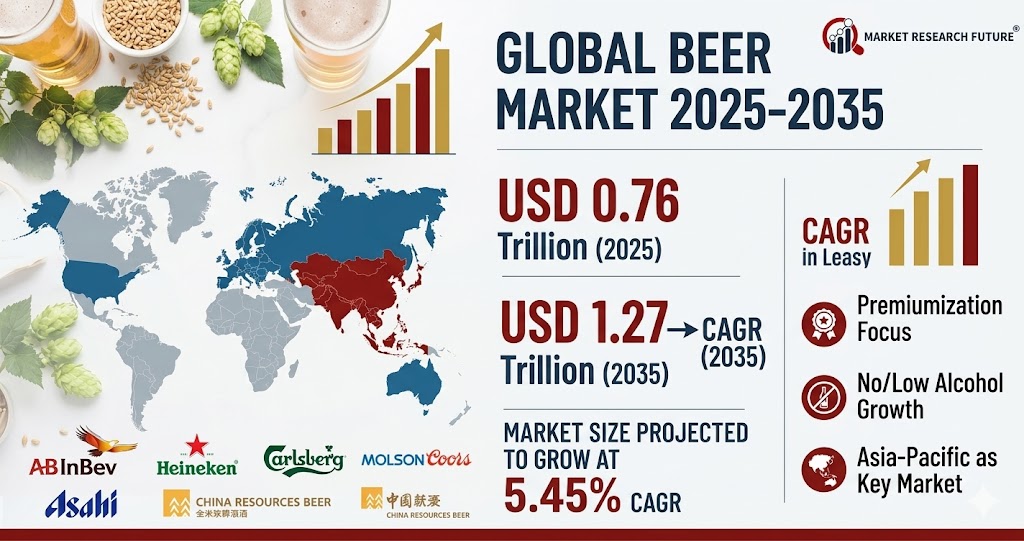
Beer Market Hits US$ 0.76 Trillion in 2025; Projected to Reach US$ 1.27 Trillion by 2035 with a Robust CAGR of 5.45%
Beer Market Report
This macroeconomic trajectory is underpinned by significant capital commitments across emerging markets, highlighted by approximately USD 14 billion in announced manufacturing capital expenditures designated between 2024 and 2027 throughout the Asia-Pacific and Latin American zones. Concurrently, operational frameworks are adjusting to modern regulatory metrics, notably the European Union’s revised Packaging and Packaging Waste Regulation (PPWR), which establishes new operational baselines for multi-market logistical and supply-chain operations.
Latest Industry Trends:
The competitive dynamics within the industry are governed by a collection of microeconomic evolutions that dictate corporate product development and capital deployment strategies:
1. Structural Shift Towards Super-Premium Offerings:
The traditional boundary between localized craft formulations and corporate premium offerings has blurred into a unified segment. Multi-national corporations are managing complex portfolios that capture premium price positions, responding to global indicators where consumer spending exhibits a distinct preference for high-tier products over mass-market variants.
2. Expansion of Low-Alcohol Beer Innovation
Driven by a demographic pivot toward moderation, non-alcoholic and reduced-alcohol variants (NoLo) have transitioned from alternative options to core category drivers. This trajectory is heavily supported by progressive fiscal adjustments in major jurisdictions, including Spain, Japan, and the United Kingdom, where reduced excise taxes for products falling below specific alcohol-by-volume thresholds permit lower market pricing and promote consumer trial.
3. Rapid Urbanization in High-Growth Corridors
Structural economic shifts across the Asia-Pacific region, alongside ongoing infrastructure developments in emerging markets, continue to expand active retail environments. The establishment of stable commercial retail networks across second- and third-tier metropolitan centers serves to accelerate per-capita consumer access to diversified brand variations.
4. Systemic Optimization of Sustainable Packaging
International producers are heavily updating their packaging infrastructure to align with regional environmental mandates. The widespread transition toward lightweight glass forms, alternative multi-pack binding configurations, and a higher reliance on aluminum formats reflects an industry-wide commitment to lowering long-term carbon output across international logistics networks.
Beer Market Drivers:
1. Elevated Global Consumption Dynamics
Consumer spending data indicates a strong willingness to absorb higher pricing tiers for specialized, authentic, or super-premium iterations, insulating enterprise margins from raw material headwinds.
2. Fiscal and Regulatory Harmonization
Structural tax incentives implemented by regional governments to favor lower-strength alcohol alternatives provide significant regulatory tailwinds for international portfolio diversification.
3. Digitalization of B2B Procurement Infrastructure
The broad introduction of direct-to-retailer application networks and integrated supply-chain technologies has optimized intermediate distribution loops, yielding improved margins and delivering granular consumer data points straight to executive teams.
Strategic Commercial Opportunities:
1. Emerging Enterprise Deployments in Sub-Saharan Africa
With localized per-capita volume tracking below mature international standards, regional hubs within Nigeria, Kenya, and Ethiopia represent primary growth vectors. Major manufacturing groups are moving forward with over USD 1.6 billion in greenfield factory installations to establish early supply stability across these expanding consumer bases.
2. Premium Non-Alcoholic Craft Formulations
The convergence of advanced craft brewing methodologies with zero-alcohol manufacturing techniques represents an under-penetrated industry niche, unlocking access to alternative dayparts and non-traditional consumption occasions.
3. Data Optimization via Direct-to-Consumer Digital Platforms
The design and deployment of enterprise B2B and subscription ecosystems allow key market participants to monitor buying preferences closely, providing an avenue to insulate brand equity and maximize localized promotional efficiency.
Request PDF Sample of Report: https://www.marketresearchfuture.com/sample_request/1647
Comprehensive Segment Analysis:
The global marketplace is evaluated across distinct product, category, packaging, and commercial delivery divisions, highlighting uneven growth rates and shifting volume allocations.
1. By Product Type
Lager: This category retained structural dominance over the international landscape in 2025, commanding an 81.4% volume share. The segment's pole position is sustained by its extensive distribution footprint, established price accessibility, and high adoption across standard consumer bases.
Ale: Characterized by specialized flavor variations and deeply rooted regional traditions, the ale segment continues to serve as an anchor for premium and specialty bars, though it faces structural competition from premiumized lager iterations.
Non/Low-Alcohol Beer: This segment is anticipated to demonstrate the quickest upward trajectory through 2035, displaying a projected CAGR of 5.62%. The expansion is heavily linked to evolving wellness behaviors displayed across younger legal-drinking-age generations.
Other Beer Types: This division encapsulates specialized regional variations, specialty seasonal products, and unique hybrids, providing important testing grounds for flavor innovation.
2. By Category
Premium: Enterprise and independent premium brands are positioned to expand at a 5.78% CAGR over the forecast horizon. This represents a value-driven transition, outperforming basic mass-market categories as buyers show a persistent interest in premium brand tiering.
Standard: While still comprising the absolute largest share of physical volume globally, the standard tier is systematically experiencing a contraction in market share, requiring companies to adjust factory outputs accordingly.
3. By Packaging Type
Cans: This format is projected to secure the fastest category expansion rate, maintaining an estimated CAGR of 5.92%. The growth is highly reflective of industry efforts to streamline global supply-chain weights and improve container recycling efficiency.
Bottles: Glass configurations remain an essential component for super-premium branding and traditional on-trade accounts, though they face strict optimization mandates due to weight constraints.
Others: This includes bulk commercial kegging structures and alternative modern storage solutions tailored for high-volume commercial transport.
4. By Distribution Channel
On-Trade: Encompassing conventional hospitality facilities, specialized taprooms, restaurants, and entertainment venues, the on-trade matrix holds a substantial revenue footprint driven by elevated per-unit margins.
Off-Trade: Representing hypermarkets, supermarkets, digital commerce portals, and localized convenience stores, the off-trade channel is navigating a steady expansion path, tracking at a projected 5.39% CAGR due to the consolidation of home consumption behaviors.
Regional Market Analysis:
The global industry exhibits a distributed footprint across multiple key geographies, each displaying unique market structures and capital priorities:
Asia-Pacific: Capturing 32.8% of global market revenue in 2025, this region functions as the primary engine for global volume and value expansion, moving ahead at a projected 5.77% CAGR. Growth within this ecosystem is led primarily by premium shifts in the Chinese and Vietnamese landscapes, alongside structural updates to alcohol distribution rules in India.
Europe: Representing the second-largest global market zone with a 27.1% baseline revenue contribution, Europe is anchored by long-term consumption histories in Germany and the United Kingdom, alongside a heavily capitalized low-alcohol innovation sector.
North America: Accounting for a 24.6% market revenue share in 2025, the region is shaped by a marked rise in premium imported options from Mexico, alongside a maturing independent craft sector requiring operational mergers.
South America: Positioned at a 9.7% regional revenue share, this market serves as a key growth catalyst, with major centers like Brazil and Mexico recording strong advances in high-tier lager demand.
Middle East & Africa: Holding a 5.8% market share, the geography is characterized by extensive greenfield brewing developments designed to serve expanding industrial city centers.
Recent Industry Developments:
The operational trajectory of the market is defined by a sequence of explicit corporate actions and infrastructural investments:
June 2026: Regulatory alignments across the European continent accelerate the implementation of new recycled-content baselines for multi-market canning facilities, triggering widespread updates to enterprise procurement protocols.
January 2026: Major brand alliances across the East Asian sector announce a series of facility retrofits aimed at integrating automated quality diagnostics and digital-twin monitoring across high-speed packaging lines.
November 2025: Leading international producers allocate capital for a series of sustainable agricultural initiatives across Western Europe, formalizing supply agreements focused on climate-resilient malting barley strains.
August 2025: Specialized production facilities in North America scale up dedicated extraction systems to satisfy rising logistical requirements for low-temperature alcohol separation technology.
March 2025: Enterprise deployment of advanced supply-chain logistics platforms expands into secondary South American metropolitan areas, connecting local distributors directly with main factory planning hubs.
Elite Corporate Profiles:
The international competitive landscape features an array of consolidated multinational entities managing multi-tiered brand portfolios:
AB InBev: Operating as the largest global brewing entity, the enterprise leverages its highly integrated B2B digital sales engine to support and scale its premiumized international labels alongside extensive localized portfolios across multiple continents.
Heineken N.V.: Centered on a premium international identity, the organization has dedicated substantial capital toward operational digitization and carbon-reduction initiatives while maintaining a frontrunner position in the global zero-alcohol category.
China Resources Beer: A dominant force across the East Asian market, the enterprise focuses on capitalizing on premium consumer shifts via strategic international collaborations and a robust domestic distribution framework.
Carlsberg Group: Grounded in Western and Eastern European brewing contexts, the group remains a key developer of functional packaging alternatives and high-efficiency manufacturing systems.
Molson Coors: Navigating structural portfolio changes across North America, the enterprise continues to optimize its standard core assets while aggressively expanding its exposure to above-premium and non-traditional beverage categories.
Asahi Group Holdings: Utilizing its foundational position in Japan, the group has systematically acquired premium international brands to establish reliable premium vectors across Europe and the Oceania region.
Constellation Brands: Driving significant import-led expansion across the North American market, the enterprise maintains an exceptionally strong presence within the premium import segment, bolstered by consistent demand spikes.
Kirin Holdings: Melding advanced biotechnological research with core brewing assets, the corporation is focusing heavily on functional health additions and specialized low-alcohol alternatives to offset mature domestic dynamics.
Strategic Macroeconomic Future Outlook:
The upcoming decade will require corporate entities to master platform economics and technological integration to insulate business models against volatile raw material inputs and shifting demographic choices. Executive teams are turning to machine-learning models to achieve tighter control over batch fermentation variance, driving energy and material efficiencies across high-volume production operations.
Simultaneously, the continuous evolution of digital commerce channels will likely convert major manufacturers into data-centric consumer goods organizations, enjoying optimized margin structures and direct oversight of localized retail dynamics. Organizations that successfully balance sustainable asset management with agile product portfolio expansion will be uniquely positioned to capture long-term value across the global food and beverage landscape.
Browse More Reports:
Non Alcoholic Beer Market
https://www.marketresearchfuture.com/reports/non-alcoholic-beer-market-3912
Root Beer Market
https://www.marketresearchfuture.com/reports/root-beer-market-27809
Black Beer Market
https://www.marketresearchfuture.com/reports/black-beer-market-41484
Fruit Beer Market
https://www.marketresearchfuture.com/reports/fruit-beer-market-6315
Sagar Kadam
Market Research Future
+1 628-258-0071
sales@marketresearchfuture.com
Visit us on social media:
LinkedIn
Facebook
X
Legal Disclaimer:
EIN Presswire provides this news content "as is" without warranty of any kind. We do not accept any responsibility or liability for the accuracy, content, images, videos, licenses, completeness, legality, or reliability of the information contained in this article. If you have any complaints or copyright issues related to this article, kindly contact the author above.
