
Digital Map Market to Reach USD 94.28 Billion by 2034, CAGR- 14.9%, Driven by AI, Smart Cities
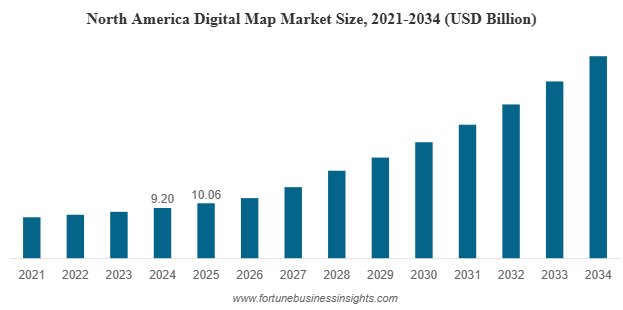
Digital Map Market Size
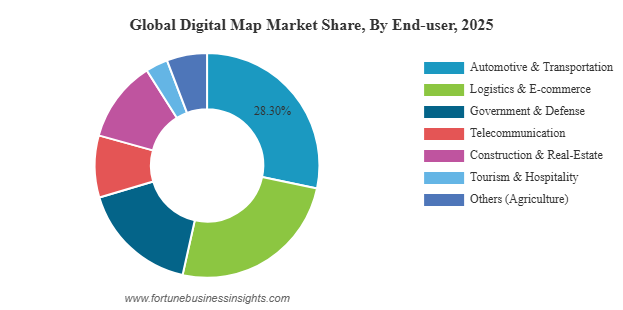
Digital Map Market Share
The Digital Map Market is projected to grow at a 14.9% CAGR through 2034, supported by AI-enabled mapping and global digital transformation initiatives.
PUNE, MAHARASHTRA, INDIA, January 29, 2026 /EINPresswire.com/ -- The global digital map market size was valued at USD 28.19 billion in 2025. The market is projected to grow from USD 30.97 billion in 2026 to USD 94.28 billion by 2034, exhibiting a CAGR of 14.9% during the forecast period. North America dominated the global market with a share of 280.21% in 2024. The rapid integration of geospatial intelligence across industries such as transportation, urban planning, logistics, automotive, and consumer services continues to strengthen the market’s long-term growth outlook.The digital map market represents a critical component of modern digital infrastructure, enabling accurate visualization, navigation, and spatial analytics across physical and virtual environments. Digital maps are increasingly embedded into enterprise systems, mobile applications, autonomous vehicles, and smart city platforms. The market is benefiting from rising demand for real-time location intelligence, cloud-based GIS solutions, and AI-powered spatial data processing, positioning digital maps as a foundational technology for next-generation decision-making.
Get Free PDF : https://www.fortunebusinessinsights.com/enquiry/request-sample-pdf/digital-map-market-111401
Digital Map Market Trends
The Digital Map Market is undergoing rapid transformation as digital and location-based technologies evolve beyond basic navigation to become core components of intelligent decision-making systems. One of the most significant trends is the integration of AI and machine learning for real-time data processing, improved map accuracy, and dynamic updates. AI algorithms now automate large-scale data collection from satellite imagery, sensor networks, and traffic flows, enabling highly accurate, context-aware mapping experiences across consumer and industrial applications.
Another major trend is the rise of augmented reality (AR) and mixed reality (MR) in digital mapping. By overlaying navigation cues, landmarks, and points of interest onto a user’s real-world view, AR/MR technologies are enhancing user engagement and usability, particularly in pedestrian navigation and indoor mapping contexts.
Real-time, high-definition maps are increasingly demanded by emerging applications such as autonomous vehicles, connected mobility platforms, and smart transportation. The need for lane-level precision and continuously updated road data is pushing providers to invest in technologies like LiDAR, 3D mapping, and sensor fusion to support advanced driver assistance systems and autonomous navigation.
Cloud-based mapping platforms and API-first services are gaining traction as businesses adopt scalable geospatial infrastructure to integrate location intelligence into digital products and services. These cloud solutions enable enterprises to deliver up-to-date mapping services across devices and applications while supporting collaboration and cross-platform integration.
Digital Map Market Growth Factors
The growth of the digital map market is driven by rising investments in smart city projects, intelligent transportation systems, and connected infrastructure. Expanding smartphone penetration and the widespread adoption of location-based services are further supporting market expansion. Government-led geospatial initiatives, improved data accuracy through satellite and sensor advancements, and the increasing need for real-time navigation and logistics optimization are also contributing significantly to market growth.
Digital Map Market Segmentation Analysis
The digital map market is segmented by component, application, end user, and region. By component, the market includes software, services, and data solutions, with software platforms holding a significant share due to high demand for cloud-based mapping and analytics tools. By application, navigation and location-based services dominate, followed by urban planning, asset management, and disaster management. End users include government, automotive, transportation & logistics, enterprise, and consumer services, with strong adoption across both public and private sectors.
Regional Insights
North America holds the major digital map market share, driven by its advanced geospatial infrastructure, strong GIS developer community, and significant presence of major technology and mapping companies. The region benefits from the early adoption of innovative mapping technologies, including AI-enabled spatial analytics, 3D mapping technologies, and cloud-based mapping platforms. The market is projected to reach USD 11.15 billion by 2026, with the U.S. alone contributing USD 9.14 billion, highlighting its continued leadership in global geospatial innovation and smart city initiatives.
Europe holds the second-largest share of the market and is projected to maintain steady growth, reaching USD 7.56 billion by 2026. This growth is supported by the region’s rapid adoption of intelligent geospatial systems and strong data privacy frameworks, promoting secure mapping solutions and increasing investments in smart infrastructure. Major contributors include the U.K. (USD 1.30 billion), Germany (USD 1.19 billion), and France (USD 0.98 billion), which are driving regional adoption and technological innovation.
In 2026, Asia Pacific is expected to witness the highest compound annual growth rate (CAGR) in the market, with a market size valued at USD 7.56 billion. This leadership is attributed to the region’s rapid digital transformation, high smartphone and IoT device penetration, and widespread adoption of mobile-first and location-based strategies by enterprises and governments. Countries such as China (USD 3.13 billion) and India (USD 1.23 billion) are at the forefront, supported by robust GIS ecosystems, expanding 5G networks, and government initiatives promoting geospatial innovation.
The Middle East & Africa region is expected to experience significant growth over the forecast period, reaching USD 2.00 billion by 2026. This growth is driven by increasing mobile and internet penetration, national digital mapping programs, and rising demand for geospatial solutions across government, transportation, and retail sectors. The GCC countries are projected to account for USD 0.60 billion, supported by modernization efforts and policy-driven geospatial initiatives.
South America is projected to reach USD 2.70 billion by 2026, driven by the growing adoption of digital maps for urban planning, logistics, mobile navigation, and smart mobility applications. The increasing adoption of smartphones and the expansion of GIS ecosystems across countries such as Brazil and Mexico continue to support market growth.
Speak To Analyst : https://www.fortunebusinessinsights.com/enquiry/speak-to-analyst/digital-map-market-111401
Top Companies in the Digital Map Market
Google LLC
HERE Technologies
TomTom International BV
Esri, Apple Inc.
Microsoft Corporation
Mapbox
Garmin Ltd., Baidu
NavInfo
Key Industry Developments
Key industry developments include increased investment in high-definition and 3D mapping solutions, partnerships between mapping providers and automotive OEMs, and the integration of AI and machine learning into spatial data processing. Companies are also expanding cloud-based mapping services and enhancing real-time data capabilities to meet the growing demand for precision, scalability, and intelligent location insights across industries.
Ashwin Arora
Fortune Business Insights™ Pvt. Ltd.
+1 833-909-2966
email us here
Legal Disclaimer:
EIN Presswire provides this news content "as is" without warranty of any kind. We do not accept any responsibility or liability for the accuracy, content, images, videos, licenses, completeness, legality, or reliability of the information contained in this article. If you have any complaints or copyright issues related to this article, kindly contact the author above.
