

Polyester Fiber Market Volume Worth 103.67 Million Tons by 2035
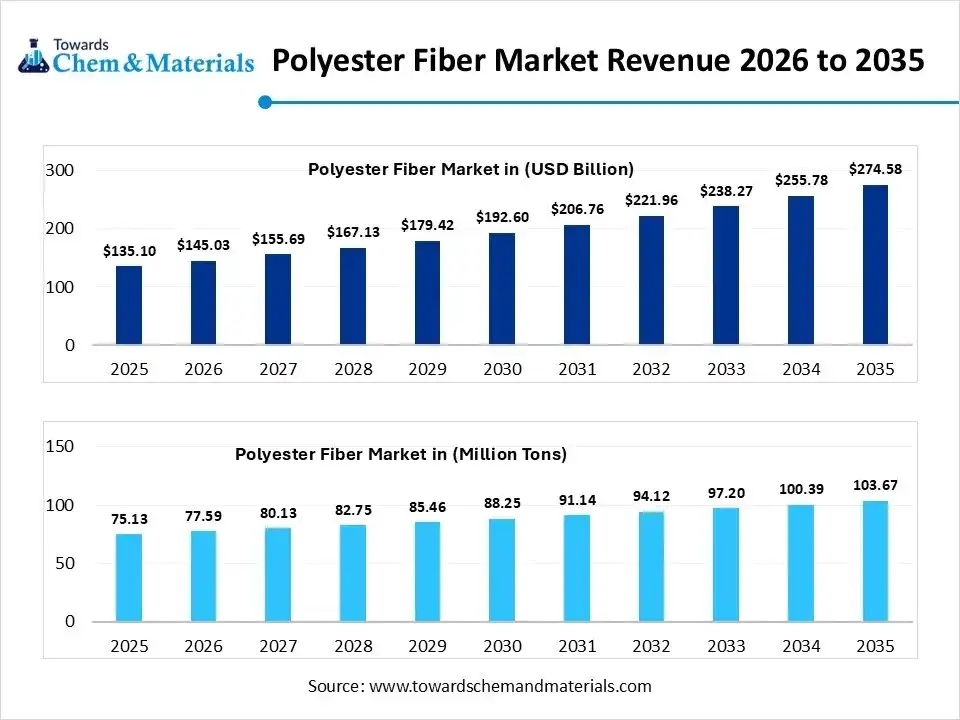
According to Towards Chemical and Materials, the global polyester fiber market volume was valued at 75.13 million tons in 2025 and is expected to be worth around 103.67 million tons by 2035, exhibiting at a compound annual growth rate (CAGR) of 3.27% over the forecast period from 2026 to 2035.
Ottawa, Jan. 19, 2026 (GLOBE NEWSWIRE) -- The global polyester fiber market size was estimated at USD 135.10 billion in 2025 and is expected to increase from USD 145.03 billion in 2026 to USD 274.58 billion by 2035, growing at a CAGR of 7.35% from 2026 to 2035. In terms of volume, the market is projected to grow from 75.13 million tons in 2025 to 103.67 million tons by 2035. growing at a CAGR of 3.27% from 2026 to 2035. Asia Pacific dominated the polyester fiber market with the largest volume share of 72% in 2025. The market is driven by stringent environmental regulation, sustainable manufacturing, and a shift towards bio-based materials and closed-loop systems. A study published by Towards Chemical and Materials a sister firm of Precedence Research.
Download a Sample Report Here@ https://www.towardschemandmaterials.com/download-sample/6122
Why is Polyester Fiber Gaining Momentum?
Polyester fiber is gaining momentum as a key driver of textile innovation, offering cost-efficiency, durability, and functional versatility. The rising demand for recycled polyester fueled a global shift toward performance-driven fabrics and the industry’s transition to a circular economy. Additionally, technological advancement enhances its texture and environmental safety by meeting the dual demand for high-performance apparel and robust industrial applications.
Request Research Report Built Around Your Goals: sales@towardschemandmaterials.com
Polyester Fiber Market Report Highlights
- By region, Asia Pacific led the polyester fiber market with the largest volume share of over 72% in 2025. The dominance and growth of the region can be attributed to rapid urbanisation.
- By product type, the polyester filament yarn (PFY) segment led the market with the largest volume share of 60% in 2025. The dominance of the segment can be attributed to the increasing consumer spending on home enhancements.
- By product type, the polyester staple fiber (PSF) segment is expected to grow at the fastest CAGR over the forecast period. The growth of the segment can be credited to its use in non-woven and car interiors.
- By grade, the PET polyester segment led the market with the largest volume share of 95% in 2025. The growth of the segment can be linked to its exceptional properties like strength, versatility, and cost-effectiveness.
- By grade, the Poly-1, 4-cyclohexylene dimethylene terephthalate (PCDT) polyester segment is expected to grow at the fastest CAGR over the forecast period. The growth of the segment can be driven by its superior durability.
- By origin, the virgin polyester fiber segment accounted for the largest volume share of 78% in 2025. The dominance of the segment is owed to its increasing use in geotextiles.
- By origin, the recycled polyester fiber (rPET) segment is expected to grow at the fastest CAGR over the forecast period. The growth of the segment is due to increasing sustainability awareness.
- By form, the solid fiber segment dominated with the largest volume share of 85% in 2025.The dominance of the segment can be attributed to its strength, durability, and affordability.
- By form, the hollow fiber segment is expected to grow at the fastest CAGR over the projected period. The growth of the segment can be credited to its better thermal insulation.
- By application, the textiles and apparel segment dominated the market and accounted for the largest volume share of 52% in 2025. The dominance of the segment can be linked to the ongoing transition towards sustainable options.
- By application, the industrial and technical textiles segment is expected to grow at the fastest rate during the study period. The growth of the segment can be driven by rapid advancements in functional fibers.
Immediate Delivery Available | Buy This Premium Research Report@ https://www.towardschemandmaterials.com/checkout/6122
Major Applications of Polyester Fibers:
- Apparel and Fashion: Polyester is widely used for shirts, trousers, and jackets because it is wrinkle-resistant, holds its shape well, and is easy to maintain.
- Sportswear and Activewear: Its moisture-wicking and quick-drying properties make it ideal for athletic gear that must handle perspiration.
- Home Furnishings: This fiber is a primary material for curtains, bedsheets, and upholstery due to its stain resistance and high color retention.
- Automotive Textiles: It is used extensively for seatbelts, tire reinforcements, and airbags because of its high tensile strength and longevity.
- Cushioning and Insulation: Polyester fiberfill (stuffing) is used in pillows, quilts, and sleeping bags to provide bulk and retain heat effectively.
- Industrial Reinforced Products: High-tenacity fibers are utilized in manufacturing conveyor belts, heavy-duty ropes, and fire hoses to ensure high-stress performance.
What Are the Major Trends in the Polyester Fiber Market?
- Circular Closed-Loop Recycling: The key shift toward closed-loop systems for high-quality new fibers, which is supported by sorting infrastructure.
- Innovation and R&D: The innovation in high-performance polyester fibers offers integral moisture-wicking, antimicrobial properties, UV protection, and thermal regulation.
- Shift Towards Bio-Based Materials: Manufacturers increasingly invest in fully plant-derived polyester from renewable resources like corn, sugarcane, and biomass. to eliminate reliance on fossil-fuel feedstocks.
- Industrial Application Growth: Apparel significantly dominated, but other technical textiles for automotive interiors, medical hygiene products, and construction for high-durability insulation and environmental resistance.
Polyester Fiber Market Report Scope
| Report Attribute | Details |
| Market size value in 2024 | USD 145.03 Billion / 77.59 Million Tons |
| Revenue forecast in 2030 | USD 274.58 Billion / 103.67 Million Tons |
| Growth rate | CAGR 7.35% |
| Forecast Period | 2026 - 2035 |
| Base Year | 2025 |
| Units Considered | Value (Billion / Million), Volume (Million Tons) |
| Dominant Region | Asia Pacific |
| Segments covered | Product Type Insights, Grade Insights, Origin Insights, Form Insights, Application Insights, Regional Insights |
| Key companies profiled | Indorama Ventures Public Company Limited, Reliance Industries Limited, Sinopec (China Petroleum & Chemical Corporation), Tongkun Group Co., Ltd., Hengli Group Co., Ltd., Alpek S.A.B. de C.V., Toray Industries, Inc., Teijin Limited, Far Eastern New Century Corporation, Nan Ya Plastics Corporation, Jiangsu Sanfangxiang Group Co., Ltd., Zhejiang Hengyi Group Co., Ltd., Shenghong Group Co., Ltd., Xinfengming Group Co., Ltd., Mitsui Chemicals, Inc., Mitsubishi Chemical Group Corporation, Toyobo Co., Ltd., Huvis Corporation, Eastman Chemical Company, Mossi Ghisolfi Group (M&G Chemicals) |
Immediate Delivery Available | Buy This Premium Research Report@ https://www.towardschemandmaterials.com/checkout/6121
Polyester Fiber Market Dynamics
Driver
The consumer demand for sustainable and closed-loop textile production is growing, driven by a shift toward recycled polyester (rPET) and circular manufacturing. By leveraging advanced chemical recycling technologies that maintain fiber integrity, companies can meet the demand for high-performance textiles and reduce environmental impact.
Restraint
What are the Primary Restraints in the Polyester Fiber market?
The most significant restraint is microplastic pollution and its environmental impact because polyester is synthetic, it sheds non-biodegradable microfibers during production and filtering that accumulate in marine ecosystems.
Market Opportunity
The emerging opportunity in the polyester fiber industry is driven by advancements in sustainability, technology, and consumer demands. The innovation in chemical recycling and the development of bio-based polyester alternatives offer more environmentally friendly solutions that are accelerating market expansion.
Polyester Fiber Market Segmentation Insights
Product Type Insights
Why did the Polyester Filament Yarn (PFY) Segment dominate the Polyester Fiber Market?
The polyester filament yarn (PFY) segment dominated the largest market in 2025 due to its high tenacity and continuous-strand structure, suitable for high-speed manufacturing. Its versatility contributes to its use in performance wear and industrial textiles, and its compatibility with automation strengthens its supply chain. Offering durability, moisture resistance, and shape retention, PFY is essential for apparel and industrial uses.
The polyester staple fiber segment is anticipated to grow fastest during the projected period, representing natural fibers while providing superior durability. Its high blending compatibility with cotton or wool creates high-performance textiles that offer resistance to wear and shrinkage. Segment driven by the non-woven industry, where these fibers are vital for hygiene, medical, and filtration products. The growth of recycled staple fibers from post-consumer waste supports sustainable, circular economy practices.
Grade Insights
Which Grade Segment Dominated the Polyester Fiber Market in 2025?
The PET grade dominates the market due to its versatility, cost-effectiveness, and recyclability. Its strength and resistance to environmental factors through its application in apparel, industrial textiles, and packaging align with sustainability goals as the foundational polymer.
The Poly-1, 4-cyclohexylene dimethylene terephthalate (PCDT) polyester segment is set to experience the fastest growth, offering superior chemical resistance and high-temperature stability. Its elasticity and durability ensemble automotive interiors, carpets, hospitality, and luxury textiles, maintaining appearance and integrity under frequent, high-heat laundering.
Origin Insights
Why Did the Virgin Polyester Fiber Segment Dominate the Polyester Fiber Market In 2025?
Virgin polyester fiber is known for purity and molecular integrity, ensuring uniformity and high tensile strength for industrial and high-end textiles. Its established manufacturing processes and reliable performance make it a common choice for large-scale manufacturing that provides a stable supply and high-quality finish for industries.
The recycled polyester fiber (rPET) segment is expected to experience the fastest growth in the market, driven by circular manufacturing and technological advances in chemical recycling, enabling its reuse without quality loss. As brands shift toward sustainability and low-carbon textile production, rPET has become mainstream in the fashion and industrial sectors.
Form Insights
How did the Solid Fiber Segment dominate the Polyester Fiber Market in 2025?
The solid fiber segment led the market due to its structural integrity and high-density construction with superior tensile strength and abrasion resistance. It is the preferred choice for heavy-duty industrial, automotive, and high-performance apparel uses. It outperforms other forms in demanding environments, maintaining standards in large-scale textile and engineering projects.
The hollow fiber segment is anticipated to have the fastest growth in the market during the forecast period, due to its lightweight construction, thermal insulation, trapping air for warmth without adding bulk, and booming outdoor gear, winter apparel, home furnishings, and automotive seating. As consumers prioritize comfort and functionality, demand for hollow fibre continues to rise in the specialized textiles and industrial sectors.
Application Insights
Which Application Segment Dominated the Polyester Fiber Market?
The textile and apparel segment dominated the market due to its versatility and global shift toward performance-driven fashion. It's dominance in sportswear and activewear, with moisture-wicking, durability, and shape retention properties. Blending polyester with natural fibers has revolutionized mass-market apparel, providing high-quality, wrinkle-resistant clothing that balances comfort and cost-efficiency. As brands adopt recycled fibers, polyester remains key to sustainable clothing.
The industrial and technical textiles segment is expected to grow at the fastest CAGR over the projected period, driven by its strength-to-weight ratio and resistance to environmental degradation. The automotive and construction sectors boost demand for high-performance polyester components like seat belts, tire cords, and advanced insulation. These applications require high-tenacity fibers to withstand mechanical stress and chemical exposure. As infrastructure and vehicle electrification expansion drive the growth.
For more information, visit the Towards Chemical and Materials website or email the team at sales@towardschemandmaterials.com| +1 804 441 9344
Driving the Future: Technological Innovations Powering the Polyester Fiber Industry
The integration of AI-optimized molecular engineering and smart fiber technology allows manufacturers to achieve self-cleaning capabilities and thermal regulation for the polymerization process. The automation improved the efficiency of production and improved fiber properties, such as increased strength and moisture management.
Regional Insights
Why did the Asia Pacific Region Dominate in the Polyester Fiber Market?
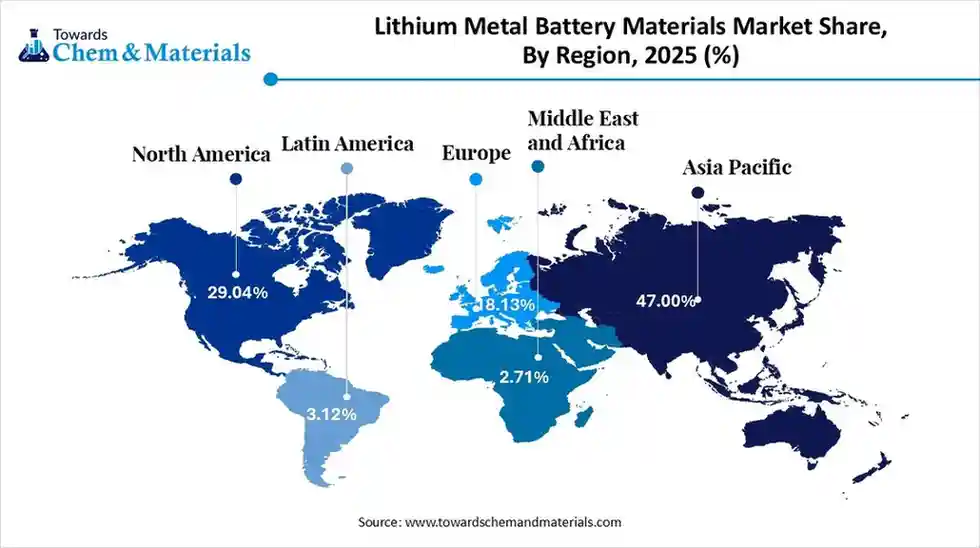
The Asia Pacific lithium metal battery materials market size was valued at USD 0.58 billion in 2025 and is expected to be worth around USD 13.05 billion by 2035, exhibiting at a compound annual growth rate (CAGR) of 36.53% over the forecast period from 2026 to 2035.
The Asia Pacific lithium metal battery materials market volume was estimated at 61,100.0 million tons in 2025 and is projected to reach 933,278.7 million tons by 2035, growing at a CAGR of 31.34% from 2026 to 2035.
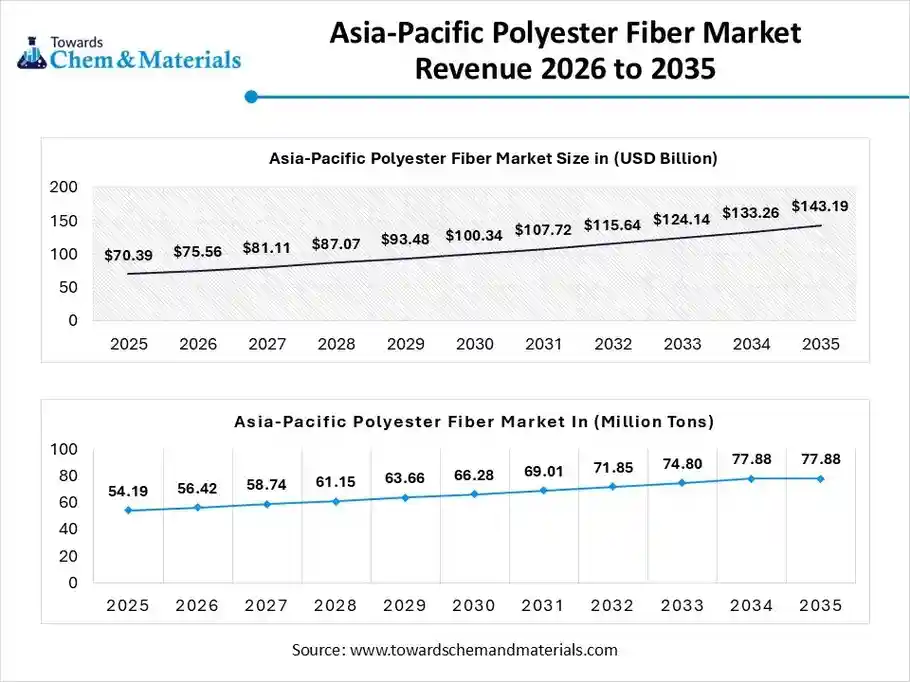
Asia-Pacific dominates the market, serving as the global hub for both production and consumption, with extensive manufacturing and an integrated supply chain that benefited from raw material feedstock. Rapid urbanization and a growing middle class fuel demand for affordable apparel, home goods, and automotive textiles. Investments in advanced and recycling technologies allow the region to remain the primary exporter of high-performance and recycled fibers.
India Polyester Fiber Market Trends
India's market is experiencing steady growth driven by rising demand from the apparel, home textiles, and automotive sectors as consumers increasingly prefer durable, cost-effective synthetic materials. Domestic production continues to scale up, with India ranking among the top global producers of polyester filament yarn and staple fiber, supported by available raw materials like PTA and MEG and government incentives under schemes such as PLI for textiles.
Why is North America Growing Rapidly During the Forecast Period in the Polyester Fiber Market?
North America is driven by demand for sustainable and high-performance textiles. The rapid adoption of recycled polyester (rPET) is increasing, with consumers prioritizing eco-friendly products. The expansion of industrial and technical textiles, such as automotive and medical applications, further supports growth. Innovation in functional fibers and efficient manufacturing processes allows North American producers to capture high-value segments, prioritizing quality and advanced properties.
Canada Polyester Fiber Market Trends
Canada's market is growing steadily, supported by expanding demand from textiles, apparel, home furnishings, and industrial applications due to its durability and cost-effectiveness. The overall polyester market in Canada is projected to expand robustly through the decade, with the fibers segment showing one of the fastest growth rates in the broader polyester product mix.
More Insights in Towards Chemical and Materials:
Unsaturated Polyester Resin Market Size to Hit USD 33.40 Bn by 2035
U.S. Recycled Polyester Market Size to Surpass USD 7.16 Bn by 2034
Polyester Hot Melt Adhesives (PHMAs) Market Size to Hit USD 1,491.92 Million by 2034
Recycled Polyester Market Size to Hit USD 38.53 Bn by 2034
Polyester Resin Dispersion Market Size to Hit USD 14.70 Bn by 2034
Asia Pacific Polymer Foam Market Size to Hit USD 131.7 Bn by 2035
Bio-polyols Market Size to Hit USD 21.47 Bn by 2035
Polyhydroxyalkanoate (PHA) Market Size to Hit USD 586.98 Mn by 2035
Organosilicon Polymers Market Size to Hit USD 29.88 Bn by 2035
Polymeric Methylene Diphenyl Diisocyanate Market Size to Hit USD 28.49 Bn by 2035
Polymer Nanocomposites Market Size to Hit USD 60.89 Bn by 2035
Polyethylene Furanoate (PEF) Market Size to Hit USD 3,233.78 Mn by 2035
Conductive Polymers Market Size to Surpass USD 14.81 Bn by 2035
Polybutene-1 Market Size to Hit USD 1,061.10 Million by 2035
Polyglycerol Market Size to Hit USD 22.30 Billion by 2035
Polymer Chameleon Market Size to Reach USD 1,225.52 Mn by 2034
U.S. Polymer Foam Market Size to Hit USD 22.83 Billion by 2034
Biopolymers Market Size to Reach USD 53.68 Billion by 2034
Liquid Crystal Polymers Market Size to Hit USD 6.73 Billion by 2034
Polymer Coated Fabrics Market Size to Hit USD 40.13 Bn by 2035
Top Companies in the Polyester Fiber Market & Their Offerings:
Tier 1:
- Reliance Industries Limited: World's largest integrated producer offering a vast range of virgin and recycled fibers under the Recron® brand.
- Indorama Ventures: A global leader providing sustainable polyester staple fibers and filament yarns for apparel, automotive, and hygiene sectors.
- Sinopec: A massive state-owned producer manufacturing a comprehensive variety of polyester chips, staple fibers, and industrial filaments.
- Tongkun Group: A top-tier manufacturer specializing in high-volume production of civilian polyester filament yarns like POY, FDY, and DTY.
- Toray Industries: Focuses on premium Toray Tetoron™ fibers used in everything from fashion and bedding to advanced industrial applications.
- Xinfengming Group: A major scale producer of diverse polyester filaments and staple fibers, including functional and eco-friendly varieties.
- Mitsui Chemicals: Primarily supplies polyester raw materials and specialized nonwoven materials rather than standard commodity fibers.
- Teijin Limited: Specializes in high-tech functional fibers like NANOFRONT® nanofibers and ECOPET™ recycled polyester for technical performance.
Tier 2:
- Far Eastern New Century Corporation
- Nan Ya Plastics Corporation
- Hengli Group Co., Ltd.
- Alpek S.A.B. de C.V.
- Jiangsu Sanfangxiang Group Co., Ltd.
- Zhejiang Hengyi Group Co., Ltd.
- Sheghong Group Co., Ltd.
- Mitsubishi Chemical Group Corporation
- Toyobo Co., Ltd.
- Huvis Corporation
- Eastman Chemical Company
- Mossi Ghisolfi Group (M&G Chemicals
Recent Breakthrough in the Polyester Fiber Industry
- In November 2025, Indorama Ventures' fibers business and Jiaren Chemical Recycling, known as a technology leader in chemical polyester recycling, formed a joint venture to accelerate circularity in the global textile industry. The strategic partnership focuses on unlocking 100,000 tonnes of annually recycled PET spinning capacity. (https://www.indoramaventures.com/en/investor-relations/newsroom/press-releases/2304/indorama-ventures-fibers-business-and-jiaren-chemical-recycling-form-joint-venture-to-enhance-global-textile-circularity)
- In January 2025, Ambercycle and Benma announced a strategic partnership to scale the production of cycora® staple fibers. The collaboration focuses on sustainable solutions to reducing reliance on virgin resources in supply chains and products. (https://www.ambercycle.com/news/ambercycle-and-benma-form-strategic-partnership-to-scale-development-of-circular-polyester-fiber)
Polyester Fiber Market Report Segmentation
This report forecasts revenue growth at global, regional, and country levels and provides an analysis of the latest industry trends in each of the sub-segments from 2019 to 2035. For this study, Towards Chemical and Materials has segmented the global Polyester Fiber Market
By Product Type
- Polyester Filament Yarn (PFY)
- Fully Drawn Yarn (FDY)
- Partially Oriented Yarn (POY)
- Draw Textured Yarn (DTY)
- Polyester Staple Fiber (PSF)
By Grade
- Polyethylene Terephthalate (PET) Polyester
- Poly-1, 4-cyclohexylene Dimethylene Terephthalate (PCDT) Polyester
- Other Specialty Co-polymers
By Origin
- Virgin Polyester Fiber
- Recycled Polyester Fiber (rPET)
- Post-Consumer Recycled (e.g., Plastic Bottles)
- Post-Industrial Recycled (e.g., Fabric Scraps)
By Form
- Solid Fiber
- Hollow Fiber
By Application
- Textiles and Apparel
- Sportswear and Activewear
- Innerwear and Intimates
- Outerwear and Casualwear
- Home Furnishing
- Bedding and Linens
- Carpets and Rugs
- Curtains and Upholstery
- Automotive and Transportation
- Tire Cords
- Seat Covers and Carpeting
- Safety Belts and Airbags
- Industrial and Technical Textiles
- Filtration Media
- Geotextiles
- Non-Woven Fabrics
- Ropes and Nets
By Regional
- North America
- Europe
- Asia Pacific
- Latin America
- Middle East & Africa
Immediate Delivery Available | Buy This Premium Research Report@ https://www.towardschemandmaterials.com/checkout/6122
About Us
Towards Chemical and Materials is a leading global consulting firm specializing in providing comprehensive and strategic research solutions across the chemical and materials industries. With a highly skilled and experienced consultant team, we offer a wide range of services designed to empower businesses with valuable insights and actionable recommendations.
Our Trusted Data Partners
Towards chem and Material | Precedence Research | Statifacts | Towards Packaging | Towards Healthcare | Towards Food and Beverages | Towards Automotive | | Nova One Advisor | Nutraceuticals Func Foods | Onco Quant | Sustainability Quant | Specialty Chemicals Analytics | TCM Blog
For Latest Update Follow Us: https://www.linkedin.com/company/towards-chem-and-materials/
USA: +1 804 441 9344
APAC: +61 485 981 310 or +91 87933 22019
Europe: +44 7383 092 044
Email: sales@towardschemandmaterials.com
Web: https://www.towardschemandmaterials.com/


Legal Disclaimer:
EIN Presswire provides this news content "as is" without warranty of any kind. We do not accept any responsibility or liability for the accuracy, content, images, videos, licenses, completeness, legality, or reliability of the information contained in this article. If you have any complaints or copyright issues related to this article, kindly contact the author above.
